Advanced Care Paramedic

Home » Programs and Training » Health and Wellness » Advanced Care Paramedic

The role of an Advanced Care Paramedic (ACP) is integral to Emergency Medical Services and provides advanced life support and medical and trauma care in health services, community, and industrial settings. They may be the first to arrive on the scene, they may be the only provider in remote areas, or they may work collaboratively in a team with other EMS/health care providers, first responders (i.e. Fire, Police) or community support agencies.

The ACP scope of practice includes, but is not limited to, the following: professional responsibilities, communication, health and safety, assessment and diagnostics, therapeutics, integration, transportation, health promotion, and public safety.

This program is not available to International Students. Our Designated Learning Institute (DLI) number is O111010246767.

Please Note:  This program is not eligible for post-graduate work permit (PGWP).


About the Program

The Portage College ACP program is delivered in 2.5 years on a full-time basis using a hybrid delivery model. This format allows students who are unable to relocate from their home community for the duration of their education program, the opportunity to pursue an Advanced Care Paramedic diploma. By using the multi-modal approach to instruction, students can do the majority of theory instruction from home. For each 3-credit course, students can expect to spend an average of 6-10 hours studying per week.
Eligibility and Testing

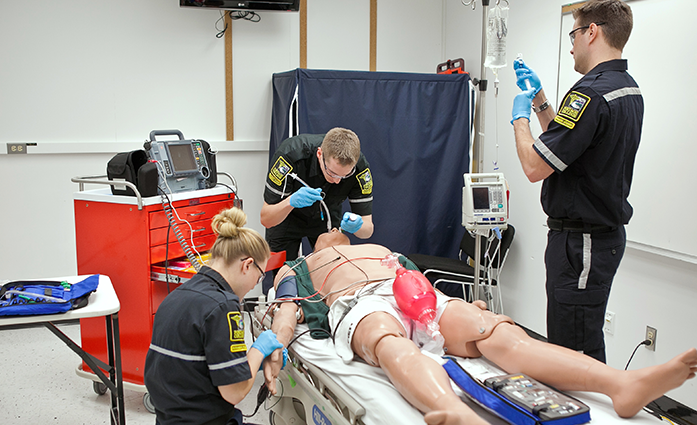
During the 13 mandatory onsite weeks, practical skills are assessed at the level of proficiency.  Some written exams are scheduled during onsite weeks but students may be required to arrange to have other exams supervised at any Portage College campus or by an approved invigilator when not on site. Students are responsible for all costs associated with exam invigilation external to Portage College. The program includes two ambulance placements and a clinical placement.

Graduates are eligible to write the Canadian Organization of Paramedic Regulators (COPR) exam. Graduates are required to be successful in order to be eligible for provincial registration with the Alberta College of Paramedics.
Career Potential
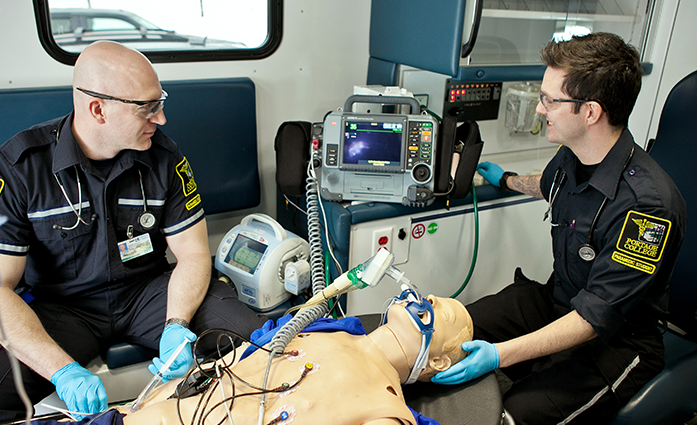
The significant demand for advanced care paramedics throughout the province in rural, urban and industrial settings provides graduates with a broad range of career opportunities.

Credentials
Year 1: N/A
Year 2: Diploma

Admission Requirements
Educational:

  • Successful completion of Primary Care Paramedic (PCP) or EMT program
  • English Language Arts 30-1 at 60% or English Language Arts 30-2 at 70%
  • Math 20-2 at 60% 
  • Biology 30 at 60%
  • Chemistry 30 strongly recommended

Use this chart to check Provincial high school equivalencies accepted at Portage College. Note: This is just a guide.

Students who do not meet admission requirements can contact Student Services regarding opportunities for placement testing. Students will need to submit an application to the program to start this process.

Required Documents:

  • High School transcripts or equivalent
  • BLS – Heart and Stroke Foundation basic Life Support for Health Care Provider (issued within one year of course start date)
  • PCP Alberta College of Paramedics practice permit will be considered an asset during the selection process.

Other:

  • Minimum age 18
  • Photocopy of current Class 4 Alberta driver’s license.
  • Completed and signed Drivers License Waiver.
  • Police Information Check and Vulnerable Sector Check within 2 months of program start date – please refer to the Alberta Health Services website student placement frequently asked questions for more information.
  • Signed Police Information Check waiver form.
  • Signed Immunization Form
  • Signed Immunization and Placement Disclosure waiver forms
  • Signed Health Status Form. Please refer to the Alberta Health Services website for student placement and frequently asked questions regarding fitness to practice as a prerequisite for placements.
  •  ESL – All students whose first language is not English must meet one of the following:
    – IELTS Academic Format with minimum scores as follows: Listening 7.5; Reading 6.5; Writing 7.0; Speaking 7.0.
    – TOEFL iBT (internet-based) with minimum test scores as follows: Listening 23; Reading 21; Writing 25; Speaking 22.
    – Testing must have been completed within two years before application to the program
  • iPad or Android tablet for use with CompTracker Program.
  • Technical and Computer Skills are required to complete the program.
  • Software Requirements:  Please refer to the following link: https://portagecollege.ca/documents/student-services/Learning%20Resources/Moodle_Collaborate_Ultra_CLASS_Technical_Requirements.pdf

Transferability
Transfer credits listed on the ACAT (Alberta Council on Admissions and Transfer) website will be approved for transfer credit to Portage College.  Specific credit awards to a program are subject to the requirements and regulations of the admitting program and may vary from the total credit awarded by Portage College.  To determine if this program transfers to other institutions, refer to the ACAT website.

Program Start/End Dates
Year 1 – August 31, 2026 to June 25, 2027
Year 2 – August 31, 2026 to June 25, 2027
Year 2.5 (Practicum) – August 2, 2026 to December 18, 2026

Application Deadline:

February 28, 2026, or until seats are filled

Program Selection Dates

Applicants will be assigned a date by the Student Advisor based on when they meet the admission requirements. Dates are as follows:
November 17, 2025
December 15, 2025
January 15, 2025
February 17, 2026
March 9, 2026
*Note: Program is competitive entry

Location

Lac La Biche Campus

Delivery
Hybrid Learning

Domestic Student Fees
Application Fee $53.50

Year 1

Fall Term
Fee payment deadline: August 15, 2025

Tuition $3,175.07
Student Association $116.70
Dental Insurance Fee $163.25
Health Insurance Fee $163.25
Technology Fee $82.71
Recreation Fee $54.57
Course Materials $172.50
Total $3,928.05

Winter Term

Fee payment deadline: December 15, 2025

Tuition $3,175.07
Student Association $116.70
Technology Fee $82.71
Recreation Fee $54.57
Comptracker 63.53
Driving Course 150.00
PBA Training 275.00
Total $3,917.58

Total tuition & mandatory fees for year one: $7,845.63

Visit  Portage Bookstore for textbooks and supplies

Domestic Student Fees
Application Fee $53.50

Year 2

Full Year
Fee payment deadline: August 15, 2025

Tuition $6,350.14
Student Association $233.40
Dental Insurance Fee $163.25
Health Insurance Fee $163.25
Technology Fee $165.42
Recreation Fee $109.14
Course Materials $172.50
Comptracker $127.05
BLS $3.85
ACLS $97.35
ITLS $168.30
PALS $3.85
TDG $24.15
WHMIS $24.15
CAMADA $60.50
Total $7,866.30

Visit Portage Bookstore for textbooks and supplies

Tuition Deposit: $1500 (non-refundable for oversubscribed programs)

Tuition is calculated using “costpercredit” one University credit is $170.00 and one Pre Health-Credit is 198.00. Calculate the cost by multiplying the number of creditper course, course dependent.

Need help funding your education? Check out our funding options.

Fee Explanations

Students’ Association Fees
These fees are authorized by student referendum and the Board of Governors. They are collected by the College on behalf of the Students’ Association in accordance with the Post Secondary Learning Act.

Health & Dental Fees
You may opt-out of the Dental and Health Insurance plan if you provide proof of comparable coverage for an extended health and/or dental care benefits plan.

Any questions regarding SA Fees including the Health and Dental Insurance fees should be directed to the SA Office 780-623-5609.

Athletics & Recreation Fees
These fees are collected to provide recreation and leisure opportunities that promote students’ physical, social, and emotional well-being, whether online or through in person facilities. Check out your +region in the link, to see what is offered at your campus or online.

Technology Fee
This is a mandatory fee assessed to students enrolling in any credit course (except for apprenticeship programs) at Portage College. The fee supports the on-going maintenance and upgrades to administrative systems that support the entire College infrastructure.

As such, it is considered a “mandatory non-instructional fee” and, therefore, is subject to Alberta Advanced Education Public Post-Secondary Institutions’ Tuition Fees Regulations. Visa students are charged the same rate as Canadian residents for this fee.

Selection Dates

Once you fulfill the educational prerequisites and provide the required paperwork, the program advisor will notify you of the exact date and time for the selection assessment. It is mandatory for you to participate in these virtual selection dates.
Advanced Care Paramedic Year One Course Listing

The ability to obtain an accurate health history and perform a systematic physical examination is essential in paramedicine practice. Paramedics must be able to accurately describe and document assessment findings. The student will learn to obtain histories and perform physical examinations when working with patients who are in different states of physical, mental, and emotional health. The Physical Examination course is designed for the student to develop skilled, efficient, thorough, and systematic histories and physical examinations.
Hours: 45
Credits: 3

This course provides an in-depth study of the structures of the human body and their interrelationships using a systems approach. The correlations between structure (anatomy) and function (physiology) are noted. Major topics include body organization, the integumentary, skeletal, muscular, nervous, respiratory, cardiovascular, lymphatic, digestive, endocrine, urinary and reproductive systems, the general and special senses, and human development. This course is designed to prepare students in medical fields of study for advanced courses in their respective fields, as well as other university transfer students.
Hours: 45
Credits: 3

This course provides a study of the overall function of the human body. Major topics include fundamental chemistry, homeostasis, cytology and cell physiology, cell signaling and communication, and muscle, nervous, respiratory, cardiovascular, lymphatic, digestive, endocrine, urinary, and reproductive physiology, as well as fundamental genetics as it applies to human physiology. This course is designed to prepare students in medical fields of study for advanced courses in their respective fields, as well as other university transfer students. Pre/Corequisites: English Lanuage Arts 30-1 at 60% and BIO 30 BIOL230
Hours: 45
Credits: 3

The Intermediate Skills course emphasizes mastery of Primary Care Paramedic (PCP) basic life support skills with the introduction of advanced practice knowledge. Students are expected to integrate core knowledge from the foundational courses, such as anatomy, physiology, physical assessment, pathophysiology, and pharmacology, as well as critical thinking and concepts of an advanced practitioner, throughout this course. The student will demonstrate proficiency in the application of all competencies in a skills, scenario, or simulation environment. Prerequisites: English Language Arts 30-1 at 60%
Hours: 45
Credits: 3

The Intermediate Skills course emphasizes mastery of Primary Care Paramedic (PCP) basic life support skills with the introduction of advanced practice knowledge. Students are expected to integrate core knowledge from the foundational courses, such as anatomy, physiology, physical assessment, pathophysiology, and pharmacology, as well as critical thinking and concepts of an advanced practitioner, throughout this course. The student will demonstrate proficiency in the application of all competencies in a skills, scenario, or simulation environment.
Hours: 143
Credits: 5

This course provides the opportunity for learners to build strategies and resources to support professional paramedic practice. Legal and ethical responsibilities in achieving and maintaining licensure under the ACP, including fitness to practice, continuing competency, and lifelong learning, will be explored. The student will gain an understanding of personality and strengths in order to help build collaborative practice and the leadership roles required of a paramedic within health systems.
Hours: 79
Credits: 2

This course focuses on the study of homeostasis and how it is altered by physical, biochemical, microbial, or genetic factors, providing an in-depth understanding of the mechanisms of human body function, pathophysiology (disordered physiology), and disease processes. The course summarizes the normal function of each organ system and presents a number of major diseases of each system, showing how symptoms and signs of selected diseases are produced by pathophysiology. This course is designed to prepare students in medical fields of study for advanced courses in their respective fields, as well as other university transfer students. Pre/Corequisite BIOL230 and BIOL231
Hours: 45
Credits: 3

Safe driving requires the adoption of an attitude toward operating a motor vehicle known as “defensive driving.” The defensive driver is not timid or overcautious but is determined to take every reasonable precaution to prevent traffic mishaps, over and above what is required by law. This course provides students the opportunity to learn and apply what is involved in driving defensively, why and how various types of motor vehicle collisions occur, and what it takes to prevent them.
Hours: 16
Credits: 1

This course focuses on the theoretical knowledge required for safe medication administration. Knowledge of human anatomy and physiology will be integrated into the curriculum as mechanisms of action, therapeutic effects, adverse effects, and drug interactions are explored. The study of common drug classifications, along with selected frequently used medications in each classification, will be included. Legislation is reviewed regarding over-the-counter and prescription drugs, as well as political, social, economic, and ethical factors that will be discussed. Applicable professional practice interventions are examined with supporting rationale.
Hours: 45
Credits: 3

This course explores basic and therapeutic communication skills for the health professional. Communication skills required for the development of caring relationships and to overcome barriers will be discussed, as well as the skills needed for interprofessional practice, group, and family communication. Conflict resolution, self-reflective practice, and health teaching are key components of this course.
Hours: 45
Credits: 3

Pregnancy, labor, and delivery are a life-changing experience for a mother and her family unit. The majority of pregnancies progress in a predictable, natural manner; however, there is the potential for life-threatening complications for the woman and fetus. Prompt recognition and treatment of these complications is essential. A paramedic can expect to encounter women in all stages of pregnancy, labor, and delivery. The Obstetrics course is designed for the student to develop skilled, efficient, thorough, and systematic approaches in the assessment and care of obstetrical patients, women in labor in all stages of pregnancy, delivery, and post-delivery. Assessments and care of the newborn will also be discussed. The knowledge and skills obtained in this course prepare the student to meet competencies related to obstetrical and neonatal patients in the clinical setting. Obstetrical and neonatal interventions are a crucial part of advanced paramedic practice.
Hours: 51
Credits: 3

Advanced Care Paramedic Year Two Course Listing

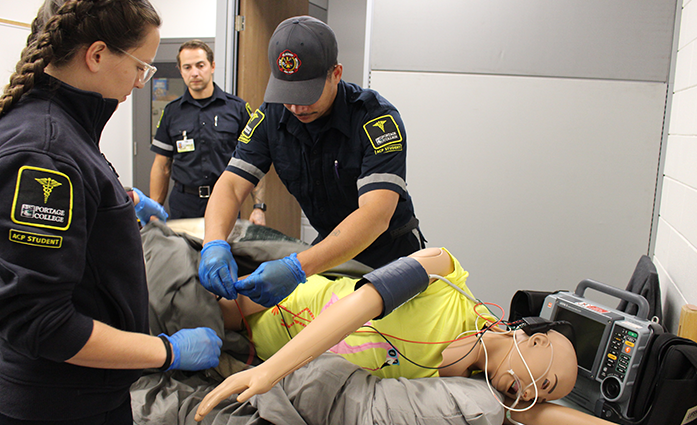
In the Advanced Paramedic Skills course, students will practice psychomotor skills related to paramedic practice as defined by the Paramedic Association of Canada: National Occupational Competency Profile and the Alberta College of Paramedics. These skills will be practiced and assessed in the skill and lab simulation environment. Students will integrate these skills into treatment plans, incorporating assessment, diagnostic data interpretation, and differential diagnosis learned in previous program courses and concurrently in ACP212 and ACP222. This knowledge will be assessed through the use of case studies, laboratory and online scenarios. Students will also incorporate principles of pain management, procedural sedation, and anesthesia in the performance of advanced interventions, as well as the use of assessment and diagnostic technologies into the ongoing monitoring of advanced interventions. In conjunction with this course, along with ACP212 and ACP222, students prepare for the transition from simulated application of clinical knowledge from the laboratory setting to the clinical and practical learning environment.
Hours: 250
Credits: 6

The Advanced Pharmacology course encompasses the knowledge of drug classes, actions, onset, duration, indications, contraindications, adverse reactions, drug interactions, administration routes, dosages, special circumstances, and drug dose calculations, which are applied in medical and traumatic situations. This course teaches students advanced concepts of pharmacology and expands the students' knowledge of the medications regularly administered within their scope of practice. There is a major focus on the importance of pharmacology and drug therapy as a complex role that sets the Advanced Life Support (ALS) Provider apart from the Basic Life Support (BLS) Provider. The student will need to apply knowledge and critical thinking to determine the appropriate medication(s) for each patient, as well as interventions that should be provided concurrently.
Hours: 90
Credits: 6

This course deals with the diagnosis and treatment of both medical and trauma emergencies at the advanced paramedic level. It is well understood that to provide safe and competent care, the advanced paramedic must quickly and efficiently assess patient signs and symptoms in the context of the setting, physical exam, history, and diagnostic findings to determine a provisional diagnosis. Differentially diagnosing between life-threatening and non-life-threatening diagnoses is an art as much as a science. Although it may not be definitive, a provisional diagnosis provides the framework to determine pharmacological & procedural interventions. The overall goal of the Emergency, Diagnosis & Treatment course is for the student to integrate knowledge, skills, and critical thinking into the scope of an advanced paramedic practitioner.
Hours: 151
Credits: 6

This course provides students with the knowledge and skills required to perform assessments and interventions on age-specific populations within the context of Advanced Care Paramedic practice. Pediatric, neonatal, and geriatric care is the focus of this course, with competency attainment at the level of proficiency during the mandatory on-site labs.
Hours: 51
Credits: 1

The initial placement course is designed to provide the student the opportunity to integrate knowledge and skills to provide care for diverse patients across the lifespan in an ambulance setting. It is the beginning of the transition toward critical thinking in advanced practice. Students are assigned to a registered ACP for the duration of their placement and will only perform skills under direct and indirect supervision. While on placement, the student acts as a role model for the profession and an ambassador for Portage College while integrating the Code of Ethics and Standards of Practice into their professional practice. The student will maintain the highest level of professionalism throughout the placement. While integrating leadership, delegation, complete physical assessments, thorough history taking, clinical presentation, and diagnostic findings, the student will begin to develop advanced care treatment plans based on the provisional diagnosis.
Hours: 384
Credits: 6

This course is designed to provide the student with the knowledge and skills required to provide safe, competent care for patients requiring air ambulance transport. The course will familiarize the student with the special aspects of patient care associated with air transport. There will be a focus placed on understanding how altitude and pressure affect human physiology, as well as the treatment variables associated with air transport. Aviation safety will be discussed. There is both a theory and a simulation component to this course.
Hours: 54
Credits: 3

The clinical placement is designed to provide the Advanced Care Paramedic (ACP) student exposure to diverse patients across the lifespan to facilitate the application of newly acquired knowledge and skills into practice in a health care facility as they rotate through various clinical areas. The clinical placement provides the opportunity for the student to incorporate assessments, advanced pharmacology, and advanced skills in the treatment of patients of all ages. Students will act as members of the multidisciplinary health team and develop an awareness of the roles and responsibilities of other health professionals while developing strategies to work effectively within a team setting. Students are assigned to an RN, RT, or physician for the duration of their placement and will only perform advanced skills under direct and indirect supervision. While on placement, the student acts as a role model for the profession and an ambassador for Portage College while integrating the Code of Ethics and Standards of Practice into their professional practice. The student will maintain the highest level of professionalism throughout the placement while integrating leadership, history, assessment, clinical presentations, and diagnostic findings into the treatment of the patient.
Hours: 270
Credits: 6

The final ambulance placement is designed to provide the student the opportunity to integrate knowledge and skills to provide care for diverse patients across the lifespan in an ambulance setting. The overall outcome of the final ambulance placement is for the student to demonstrate confidence and meet requirements to practice ACP competencies at the proficiency level. Emphasis is placed on demonstrating critical thinking and leadership skills by managing the overall advanced care of the ill or injured patient and the resources on hand, independent of the preceptor, while under indirect supervision. Students are assigned to a registered ACP for the duration of their placement and will only perform skills under direct and indirect supervision. While on placement, the student acts as a role model for the profession and an ambassador for Portage College while integrating the Code of Ethics and Standards of Practice into their professional practice. The student will maintain the highest level of professionalism throughout the placement. While integrating leadership, delegation, complete physical assessments, thorough history taking, clinical presentation, and diagnostic findings, the student will develop and implement advanced care treatment plans based on the provisional diagnosis.
Hours: 576
Credits: 6